
Sending a parcel from the United Kingdom to India takes planning. Different rules apply for everyday items, high‑value goods and personal gifts, and these rules change over time. If you pack without checking the rules, your shipment might be held by customs or returned. This guide explains every step of shipping to India. It shows how to calculate costs, what customs paperwork you need and how to pack your parcel so it arrives safely. You’ll also learn which everyday items can travel without restrictions and which items are banned outright.
When you choose courier to India services you must also think about speed and convenience. Couriers collect from your door and give tracking updates so you always know where the parcel is. However, not everything can be sent by courier. This guide lists 50 examples of things you can and cannot send to India and explains the difference between a normal postal service and an express courier. By the end, you’ll be ready to ship gifts to family, documents to clients or goods to customers with confidence.
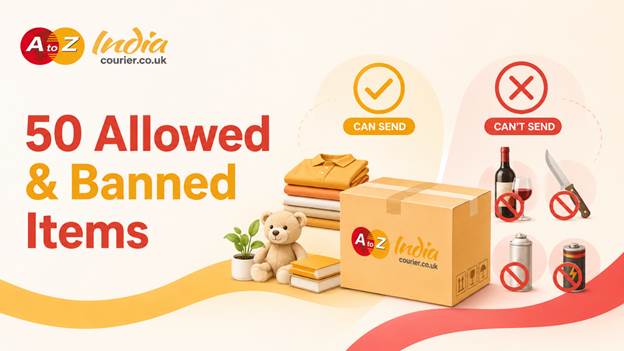
These items pass through Indian customs without major issues. You still need to declare them on the customs form, and some carry duty if their value crosses the exemption threshold, but they are legally allowed for import.
You can send new or used clothes, including shirts, trousers, dresses, coats, sarees and traditional outfits. Declare them as personal clothing and state whether they are new or used. New clothes above the gift value limit may attract duty.
Books, magazines and educational printed materials can be sent without major restrictions. Pack them flat and declare them as printed books. Avoid banned, obscene or sensitive material.
You can send new or used shoes, sandals, slippers and sports footwear. Used shoes must be clean. Declare each pair and state whether they are new or used.
You can send sealed dry foods such as biscuits, chocolates, tea, coffee, spices, dry fruits and cereal. Food must be commercially packed, sealed and within expiry date. Do not send homemade, open or perishable food.
You can send children’s toys, puzzles, board games and educational toys. Toys with batteries must follow battery rules. Avoid realistic weapon-style toys.
You can send phones and tablets, but declare the model, value and IMEI number. New devices may attract duty. Used devices should be marked as used personal items.
You can send laptops, desktops and monitors. Declare the model, serial number and value. New items may attract duty, while used personal devices may clear more easily.
Artificial and imitation jewellery can be sent if it is not made from precious metals or stones. Declare it clearly as imitation jewellery to avoid confusion with gold or silver items.
You can send sealed retail cosmetics such as lipstick, soap, shampoo and skincare products. Avoid homemade cosmetics and aerosols. Declare each item clearly.
You can send UK-bought herbal or Ayurvedic products in sealed packaging. The label must show all ingredients. Check ingredients before sending because some herbs may be restricted.
Pens, pencils, notebooks, paper, folders, calculators and office supplies can be sent for personal use. Commercial quantities may need import paperwork.
You can send pots, pans, plates, cutlery and kitchen tools. Do not send items with fuel or gas parts. Declare them as personal kitchen items.
Bedsheets, pillowcases, blankets, duvets and towels can be sent. New or used personal linen usually clears without major issues. Declare whether the items are new or used.
You can send personal medical devices such as blood pressure monitors, glucose meters, hearing aids and mobility aids. Some items may need a prescription or doctor’s letter.
Prayer books, idols, incense, camphor and religious items can be sent for personal use. Avoid items made from restricted wood, ivory or protected animal products.
Printed photos, photo albums, framed pictures and digital photo frames can be sent. These are usually treated as personal effects.
You can send guitars, violins, keyboards, sitars and other instruments. Pack them in hard cases where possible. Declare them as personal musical instruments with value.
You can send cricket bats, footballs, rackets, gym items and yoga mats. Avoid equipment with gas cylinders, air guns or compressed cartridges.
Standard watches can be sent. Smartwatches should be declared as electronics. Gold, platinum or luxury watches may need extra checks and duty payment.
You can send cushions, curtains, wall art, candles, vases and small decorative items. Avoid products made from ivory, bone, reptile skin or banned wildlife materials.
These items are allowed into India, but they come with rules. You may need special documentation, the quantity may be limited, or duty will apply.
Devices with lithium batteries can be sent if the battery stays inside the device. Loose or spare lithium batteries are usually banned. Check the courier battery limits before booking.
Gold and silver jewellery can attract strict customs checks and duties. Declare the weight, value and material accurately. Under-declaring can lead to seizure or penalties.
Alcohol is heavily restricted, and many couriers refuse it. If accepted, it must be declared by type, volume and alcohol content. Duty can be high, and Indian state rules may differ.
Prescription medicines can be sent for personal use with a prescription and doctor’s letter. Keep quantities reasonable. Controlled or narcotic medicines are prohibited.
Seeds need a phytosanitary certificate and import permit. Without these documents, customs may confiscate them. Fresh plants and cuttings should not be sent.
Cash is restricted and most couriers refuse it. Do not send Indian rupees or foreign notes by parcel. Use a bank transfer or remittance service instead.
Sealed dry fruits and nuts can be sent for personal use. Loose or unpacked items may be seized. Large quantities may be treated as commercial imports.
Perfumes are restricted because they contain alcohol. Many couriers limit or refuse them. If accepted, they must be in original packaging and declared by volume.
Leather bags, wallets, belts and jackets can be sent if made from common leather. Items made from snake, crocodile, lizard or other protected species are banned.
Vapes, e-cigarettes and vape liquids cannot be sent to India. They are banned and may be confiscated.
Vitamins, protein powders and supplements can be sent if sealed and labelled. Check ingredients before sending. Restricted ingredients can lead to seizures.
Cameras, lenses and accessories can be sent. Declare the model, serial number and value. Batteries must follow lithium battery rules.
Dry car parts can be sent if clean and free from oil, fuel or fluid. Parts with residue may be rejected. Declare them as non-hazardous auto parts.
Furniture can be sent by cargo or large-shipment service. New furniture may attract duty. Wooden furniture may need pest-treatment certification.
Software on CDs, DVDs or USB drives can be sent if legal and licensed. Pirated software or illegal content is banned. Declare the title and format.
These items are banned from import into India. No exceptions. If you include any of these in your parcel, the items will be confiscated. You will not get compensation. Your parcel may be destroyed or returned at your expense. Do not attempt to send any of the following.
Illegal drugs, cannabis, cocaine, heroin, opium and controlled narcotics are completely banned. Sending them can lead to seizure and legal action.
Guns, ammunition, explosives, fireworks, replica firearms, air guns, knives and self-defence sprays are banned. Do not send any weapon-type item.
Pornographic or obscene material is banned in all formats, including magazines, DVDs, USB drives and printed photos. Customs can confiscate it.
Fake branded goods, counterfeit currency, forged documents, pirated media and replica designer items are prohibited. Customs may seize and destroy them.
Ivory, tortoiseshell, reptile skin, rare hardwood, stuffed wildlife and endangered-species products are banned. These items are protected under CITES rules.
Fresh meat, fish, poultry, cheese, milk, butter and dairy products cannot be sent by normal parcel. These are biosecurity risks and may be destroyed.
Live animals, birds, fish, insects, plants and cuttings cannot be sent by courier. Pet relocation needs specialist transport and official documents.
Radioactive substances and items containing radioactive elements are banned from normal courier shipping. They require specialist handling and licences.
Poisons, pesticides, herbicides, toxic chemicals, solvents and hazardous cleaning products cannot be sent. Avoid anything with a hazard symbol.
Asbestos and products containing asbestos fibres are banned. Check old building materials or vintage items before shipping.
Human remains and ashes cannot be sent by standard courier. They require specialist repatriation services and official documentation.
Aerosols, gas cylinders, butane, propane, CO2 cartridges, deodorant sprays and fire extinguishers are banned from air freight.
Petrol, diesel, kerosene, solvents, paint thinners, matches, firelighters and flammable adhesives are banned. Most couriers refuse flammable goods.
Uncut diamonds, rough precious stones and loose pearls cannot be sent by courier. These are tightly controlled to prevent smuggling and fraud.
Some Bangladesh-made goods may face import restrictions in India. This mainly affects commercial shipments or large quantities. Check customs rules before sending.
Shipping costs from the UK to India depend on the parcel weight, dimensions, delivery speed, and the courier you choose. Below are estimated prices for standard courier services from the UK to India. These are approximate rates and may vary depending on the exact service, fuel surcharges, and seasonal demand.
| Parcel Weight | Economy (6-16 Days) | Express (2-5 Days) |
| 0.5 kg | 15 – 25 GBP | 35 – 55 GBP |
| 1 kg | 18 – 30 GBP | 40 – 65 GBP |
| 2 kg | 22 – 38 GBP | 50 – 80 GBP |
| 5 kg | 35 – 55 GBP | 70 – 120 GBP |
| 10 kg | 50 – 85 GBP | 110 – 180 GBP |
| 20 kg | 80 – 140 GBP | 180 – 300 GBP |
| 30 kg | 110 – 190 GBP | 250 – 420 GBP |

Shipping is a general term for sending goods overseas. It often refers to sea freight or standard postal services that move parcels in bulk and take longer. A courier is an express service that moves parcels by air. Couriers collect from your door, handle customs paperwork and deliver to the recipient’s door. Both methods allow you to send packages to India, but the cost, speed and service level differ. Express couriers usually take 3–5 days while economy services may take 8–12 weeks.
| Service type | Speed (approx.) | Features | Example cost* |
| Express air courier | 3–5 business days | Door‑to‑door, tracking, customs support, signature on delivery | Around £30–£50 for a 5 kg parcel, depending on the provider and time of year |
| Economy air courier | 7–15 business days | Door delivery or collection point, standard tracking | From £15–£30 for 5 kg |
| Sea freight/cargo | 8–12 weeks | Port‑to‑port or door‑to‑door for heavy items | Cheapest per kilogram for shipments over 50 kg |
*Prices are estimates based on 2026 rates from UK carriers such as Royal Mail and independent couriers. Actual charges vary by weight, size and service.
Every international parcel needs correct paperwork. For commercial goods, you must provide a commercial invoice that lists the seller and buyer details, item descriptions, quantities, unit prices, total value, Harmonised System (HS) codes and country of origin. For gifts or samples, you use a proforma invoice marked “gift – no commercial value”. Postal services use customs declaration forms CN22 for parcels valued under £270 and CN23 for higher‑value items. Attach the completed form to the parcel so customs officers can inspect it without opening the package.
India categorises imports into three groups. Freely importable goods can be imported without special licences but must follow normal customs procedures and duty payments. Restricted goods require licences or permits from agencies such as the Directorate General of Foreign Trade (DGFT). Prohibited goods are banned completely.
India charges customs duty and Goods and Services Tax (GST) on most imported goods. The duty rate depends on the HS code and declared value. For gifts sent from individuals abroad to individuals in India, customs duty and IGST are waived if the declared value does not exceed ₹10,000 (about £100). Gifts above this value are subject to customs duty and IGST. Always declare the true value; under‑declaring is illegal and may result in fines.
| Item Category | Estimated Duty Rate | Notes |
| Electronics (phones, laptops) | 18% – 25% | Varies by item and value |
| Clothing and textiles | 25% – 30% | Higher for new commercial quantities |
| Cosmetics | 25% – 30% | On declared value above exemption |
| Gold jewellery | 15% + 3% GST | Strict weight and value declaration |
| Alcohol | 100% – 150% | State laws may add extra charges |
| Books | 0% | Duty-free for personal use |
| Medicines (personal use) | 0% – 10% | With valid prescription |
| Gifts up to 10,000 INR | 0% | Exemption applies to full value |
Courier charges are based on the greater of actual weight and volumetric weight. To calculate volumetric weight, multiply the length, width and height (in centimetres) and divide by 5000. If your parcel measures 50 cm × 40 cm × 30 cm, the volumetric weight is (50 × 40 × 30) ÷ 5000 = 12 kg. If the actual weight is 8 kg, you will be charged for 12 kg. Use appropriately sized boxes and remove excess packaging to reduce volumetric weight.
Quality packing materials prevent damage and ensure customs clearance:
Write the address clearly in English and include:
Example shows the correct format:
Mr XYZ
Flat 301, Surya Apartments
MG Road, Koramangala
Bangalore, Karnataka – 560034
INDIA
+91 XXXXXXXXXX
Include a customs declaration (CN22 or CN23) attached to the parcel. List every item with its HS code, quantity and value. Provide invoices, prescriptions or datasheets in a transparent pouch so customs can verify contents without opening the box. Declare the true value to avoid fines.
Start by deciding what you are sending and its urgency. Check whether the item is allowed, restricted or prohibited. If the item is allowed, estimate its weight and dimensions. Compare express courier, economy air and sea freight options. Check approximate transit times and prices (see table above). Avoid shipping around major Indian public holidays—Republic Day (26 January), Holi (March), Independence Day (15 August), Diwali (October/November) and Christmas Day (25 December)—because customs offices may be closed.
Choose the right box. Use strong packaging, wrap fragile items individually and fill voids to stop movement. Remove manufacturers’ packaging for smaller goods to reduce weight and dimension where possible. Seal all seams with heavy tape and label boxes containing fragile items with “fragile” and “this way up” stickers.
Complete a commercial or proforma invoice. Include accurate descriptions, HS codes and values. For gifts, mark the invoice as “gift” and keep the value under ₹10,000 to benefit from duty exemption. Fill out the CN22 or CN23 customs declaration and attach it to your parcel. Provide contact details for both sender and recipient.
Choose a courier or postal service based on your budget and time frame. Many UK carriers offer online booking with door collection. When booking, provide parcel dimensions, weight, destination address and invoice details. Consider adding insurance if your items are valuable; standard compensation is often limited to £20–£50.
Once collected, monitor your parcel using the tracking number provided. Express couriers offer real‑time tracking and notifications. Stay in contact with the recipient; they may need to pay customs duty or provide identification for clearance. If customs holds the parcel due to missing documents, you can supply the required information quickly via email.
| Item | Status | Key Condition |
| 1. Clothes and garments | Can send | Declare new or used |
| 2. Books and printed material | Can send | Duty-free for personal use |
| 3. Shoes and footwear | Can send | Must be clean if used |
| 4. Non-perishable food (sealed) | Can send | Commercial packaging only |
| 5. Toys and games | Can send | No realistic weapons |
| 6. Mobile phones and tablets | Can send | Declare IMEI number |
| 7. Laptops and computers | Can send | Battery rules apply |
| 8. Imitation jewellery | Can send | Declare clearly as imitation |
| 9. Cosmetics (sealed) | Can send | No aerosols |
| 10. Herbal products (UK-sold) | Can send | Sealed, listed ingredients |
| 11. Stationery and office supplies | Can send | No restrictions |
| 12. Kitchen utensils and cookware | Can send | No gas canisters |
| 13. Bedding and linen | Can send | Declare new or used |
| 14. Medical devices (personal) | Can send | May need prescription |
| 15. Religious items and pooja supplies | Can send | No sandalwood items |
| 16. Photographs and albums | Can send | No restrictions |
| 17. Musical instruments | Can send | Pack in hard cases |
| 18. Sports equipment | Can send | No gas canisters |
| 19. Watches (non-precious) | Can send | Declare value |
| 20. Home decor and furnishings | Can send | No animal products |
| 21. Electronics with batteries | Restricted | Battery inside the device only |
| 22. Gold and silver jewellery | Restricted | High duty, strict declaration |
| 23. Alcohol and spirits | Restricted | High duty, many couriers refuse |
| 24. Prescription medicines | Restricted | Need prescription and letter |
| 25. Seeds and plant material | Restricted | Need phytosanitary certificate |
| 26. Currency and cash | Restricted | Most couriers refuse cash |
| 27. Dry fruits (commercial pack) | Restricted | Personal quantity only |
| 28. Perfumes and fragrances | Restricted | Dangerous goods rules apply |
| 29. Leather goods | Restricted | No endangered species leather |
| 30. Vapes and e-cigarettes | PROHIBITED | Complete ban since 2019 |
| 31. Dietary supplements | Restricted | Check ingredient legality |
| 32. Camera equipment | Restricted | Battery rules, declare serial |
| 33. Car parts (dry only) | Restricted | No fluids or residual oil |
| 34. Furniture | Restricted | Wood certification needed |
| 35. Software on physical media | Restricted | No pirated content |
| 36. Narcotics and illegal drugs | PROHIBITED | Criminal offence |
| 37. Firearms and weapons | PROHIBITED | Includes replicas and air guns |
| 38. Pornographic material | PROHIBITED | All formats banned |
| 39. Counterfeit goods | PROHIBITED | Includes fake brands and currency |
| 40. Endangered animal products | PROHIBITED | CITES enforcement |
| 41. Fresh meat and dairy | PROHIBITED | Biosecurity risk |
| 42. Live animals and plants | PROHIBITED | Use specialist services |
| 43. Radioactive materials | PROHIBITED | Specialist handling only |
| 44. Hazardous chemicals | PROHIBITED | No items with hazard symbols |
| 45. Asbestos products | PROHIBITED | Complete ban |
| 46. Human remains and ashes | PROHIBITED | Use repatriation services |
| 47. Compressed gases and aerosols | PROHIBITED | Dangerous goods ban |
| 48. Flammable liquids and solids | PROHIBITED | No solvents or fuels |
| 49. Uncut diamonds and stones | PROHIBITED | Anti-smuggling rule |
| 50. Certain Bangladeshi goods | PROHIBITED | Trade agreement restrictions |
Go through this checklist before you seal your parcel and book your courier. It takes two minutes and can save you days of delay and unexpected costs.
Shipping a parcel to India from the UK does not need to be complicated. The rules are clear once you know them. Check what you are sending, declare it properly, pack it well, and use a reliable courier service. Follow this guide and your parcel will reach its destination without the problems that catch out so many UK senders.
Yes. HS codes classify products internationally and determine duty rates. Incorrect codes may result in higher duties or customs delays. You can search for the correct code using online databases or ask your courier.
If the gift’s declared value is under ₹10,000, it is exempt from duty. If it exceeds, the recipient must pay customs duty and IGST. You cannot split a single gift into separate parcels to avoid duty; customs may combine shipments if they arrive simultaneously.
Common reasons include undeclared or under‑declared items, missing invoices, restricted items without licences or incorrect documentation. Ensure all paperwork is complete and accurate. Provide a local phone number so customs can contact the recipient.
Non‑perishable foods like canned goods and sealed snacks are generally allowed. Fresh meat, dairy products and homemade pickles require veterinary or food safety certificates and are often restricted or prohibited. It is safer to avoid perishable goods.
Customs will confiscate prohibited items and may return or destroy your parcel. You could face fines or blacklisting by courier companies. Always review the prohibited list before shipping.