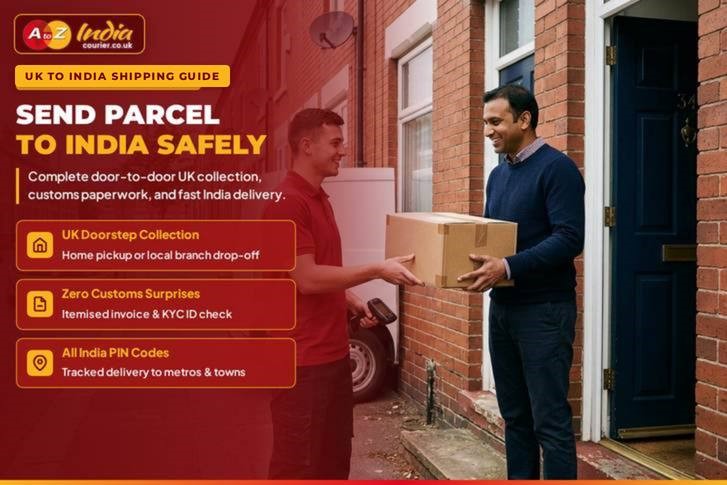
To send parcel to India from the UK without delays, pack allowed goods in a double walled cardboard box, list every item with its true value on the invoice, and match the receiver’s full legal name to their Indian government ID. Most boxes face holds at Indian customs because of vague gift labels, missing six digit PIN codes, or unverified Know Your Customer (KYC) documents, not slow flights.
Every non document shipment entering India passes through electronic clearance under the Central Board of Indirect Taxes and Customs (CBIC). Your best transport route depends on box weight, outer size, item type, and urgency. Air freight moves urgent gifts, documents, and light cartons within seven to fifteen working days, whereas sea cargo suits heavy household loads over twenty kilogrammes that can travel for three to four months. Below are the exact rules, paperwork checks, and packing steps for safe delivery across India.
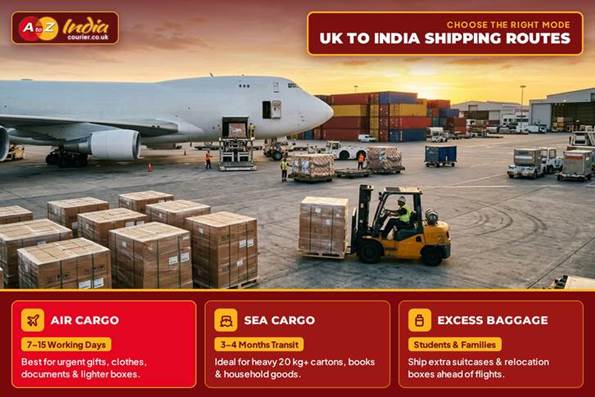
Picking the right route before sealing your box prevents wrong handling and transit delays. Senders with urgent gifts, festival clothes, or samples book air cargo to India because flights leave UK hubs daily and reach Indian addresses within two weeks. Pure paperwork such as certificates and legal files should go through a dedicated send documents to India channel, which clears X ray checks faster than mixed parcels.
Heavy cartons over twenty kilogrammes suit sea cargo to India best. Shared container space moves bulky books, kitchenware, and household clothes that do not need fast delivery. Students and travellers with extra suitcases can book unaccompanied excess baggage shipping to India ahead of their flight instead of carrying heavy bags through airport check in. Every route connects with door to door cargo to India, covering UK pickup, export paperwork, customs clearance, and local delivery under one tracking number.
| Shipping Route | Best Items to Ship | Weight Basis | Typical Transit |
| Air Cargo | Urgent gifts, clothes, dry snacks, samples | Higher of scale or volumetric | 10 to 15 working days |
| Sea Cargo | Heavy boxes (20 kg+), books, kitchenware | Box weight and item category | 3 to 4 months |
| Excess Baggage | Suitcases, student cartons, relocation goods | Actual or dimensional weight | Around 2 weeks by air |
| Document Courier | Certificates, contracts, printed files | Envelope weight (up to 2 kg) | Express air priority |
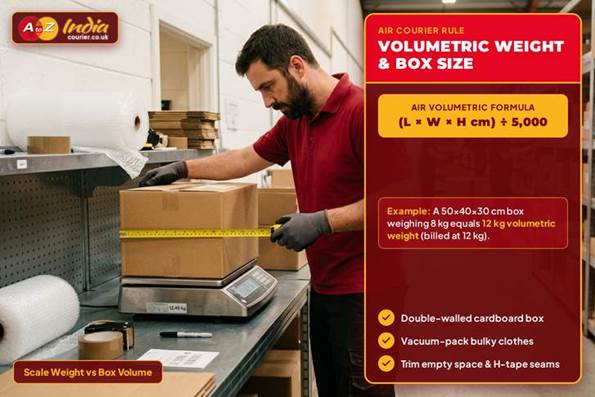
Air carriers do not charge by scale weight alone because aircraft holds run out of space before weight limits. Each air box is checked twice: on scales for actual weight in kilogrammes, and with a tape measure for volumetric weight. Multiply length, width, and height in centimetres, then divide by 5,000. Carriers use whichever figure is higher as the chargeable weight.
A large box half filled with light coats often surprises senders. A carton measuring 50 cm by 40 cm by 30 cm may weigh only 8 kg on scales, yet its volumetric weight is 12 kg (60,000 divided by 5,000), so it bills at 12 kg. When shipping personal belongings to India, pack soft clothes in vacuum bags, choose a snug double walled box, and cut down tall flaps before taping so you do not pay for empty space.
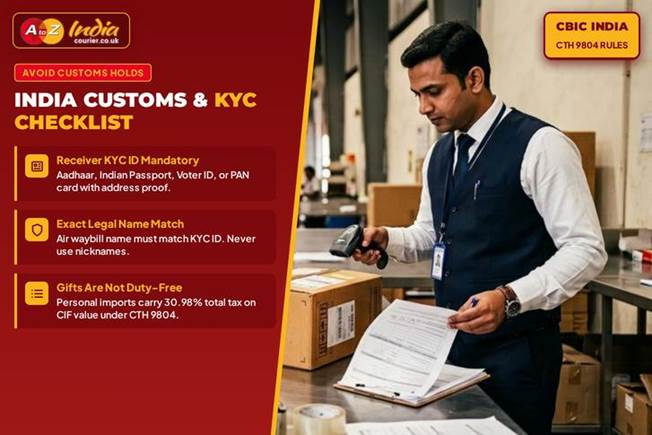
Marking a box as a ‘gift’ does not make it duty-free in India. Under CBIC tariff heading 9804—personal courier imports carry 10% Basic Customs Duty, a 10% Social Welfare Surcharge on that duty, and 18% Integrated Goods and Services Tax (IGST). That equals 30.98% total tax on the Cost, Insurance, and Freight (CIF) value. Only narrow legal exemptions, such as approved life-saving medicines, are tax-free, and the receiver in India pays any assessed duty before delivery.
Indian customs also requires Know Your Customer (KYC) checks on every non document box. Before release, the receiver must upload one valid Indian ID—an Aadhaar card, Indian passport, Voter ID, or PAN card—plus clearance authorisation. Because a PAN card or foreign passport lacks a local Indian address, receivers using them must add separate address proof. Never use nicknames or short names on the air waybill. If the label name does not match the KYC card letter for letter, customs holds the parcel in bond, and boxes left uncleared past thirty days risk detention.
Exact item lists speed up customs screening. Avoid vague words like ‘gifts’ or ‘personal items’. Write clear lines with quantities and true values in pounds, such as ‘four women’s cotton kurtas’ or ‘two pairs of children’s shoes’. Business shipments also need Harmonised System (HS) codes, a commercial invoice, and the buyer’s Importer Exporter Code (IEC).
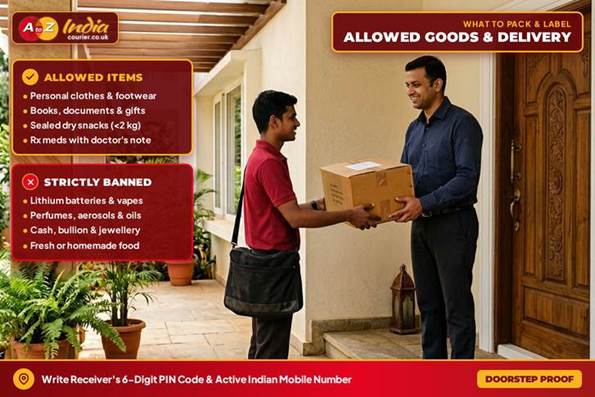
Everyday family parcels clear UK export screening and Indian customs smoothly when packed in normal home quantities. Sending fifty identical tagged shirts looks like trade stock even if sent to family. Shop bought biscuits, tea, and chocolates must stay in sealed factory wrappers with expiry dates, and keeping total dry food weight under two kilogrammes avoids commercial food checks.
Air safety laws and Indian import rules ban dangerous and liquid goods from parcel networks. Hiding banned goods inside clothes triggers X-ray alerts, carrier fines, or customs seizure. Check your items against these three groups before packing:
UK drivers collect parcels at ground floor level and accept rigid cardboard boxes rather than soft holdalls or bin bags on standard parcel routes. Double-walled cartons protect goods through van sorting, flight loading, and Indian road transit. Follow these five steps before booking parcel delivery to India from the UK:
Wrong or missing six-digit PIN codes cause most failed deliveries in India, while a working Indian mobile number lets the receiver get KYC upload links and delivery calls on time. Whether you drop off at a UK branch in Wembley, Southall, Hounslow, Harrow, Hayes, East London, or Leicester, or book home pickup from any UK postcode, A to Z India Courier checks your item list and paperwork before dispatch.
Air cargo door-to-door delivery from the UK to India takes 7 to 15 working days after dispatch. Sea cargo suits heavy, non-urgent boxes and takes 3 to 4 months.
No. Indian customs does not give general duty-free clearance to courier gifts. Under CBIC rules (heading 9804), personal imports carry a 30.98% total tax on CIF value.
The receiver in India pays any customs duty and IGST assessed by Indian customs before final delivery. Standard UK courier quotes cover transport and handling only.
The receiver must submit one valid Indian ID—an Aadhaar card, Indian passport, Voter ID, or PAN card (with address proof)—plus courier authorisation matching the air waybill name.
Multiply box length, width, and height in centimetres and divide by 5,000 to get volumetric weight in kilogrammes. Air couriers bill whichever is higher: scale weight or volumetric weight.
Yes, new and clean used personal clothes and shoes are allowed in normal personal quantities. List each item type, count, and honest value on your packing list.
Yes, shop bought dry foods like chocolates, biscuits, tea, and dry fruits are allowed in unopened factory wrappers with expiry dates. Keep total food weight under 2 kg.
Personal prescription medicines need approval before booking and must include a doctor’s prescription, chemist receipt, and matching patient ID. Unlabelled pills, liquids, and banned drugs are refused.
Banned items include lithium batteries, power banks, vapes, perfumes, aerosols, flammable liquids, cash, gold or silver jewellery, alcohol, fresh or homemade food, fake brands, weapons, and satellite phones.
Yes, unaccompanied excess baggage shipping moves suitcases and boxes separately by air or sea from your UK home to India, avoiding steep airline check-ins charges.
Indian customs match the air waybill and invoice against the receiver’s official KYC card. Nicknames or short names block clearance until a notarised affidavit is provided.
Every shipment gets a tracking number at booking. You can check collection, UK export dispatch, Indian customs clearance, and local PIN code delivery online or via the app.